
Date: 11/15/2025
TABLE OF CONTENTS
Introduction
Hi! If you know me, you know that I foam at the mouth at the thought of trains; they make me go off the rails in excitement. Anyway, I will be starting a series where I will share a bunch of stuff on trains as well as public transportation in general in the US.
This post will be focusing on a broad history of trains and general transportation infrastructure in the US. I hope that after you're done reading this, you learned about why car-centric urban design is bad and why you should like trains more than you currently do.
History/Rant
Railways originated in Germany in the 1550s; however, the first steam locomotives came from Great Britain at the dawn of the 19th century. They were initially intended to haul coal but were soon adapted to hold passengers.1
Locomotives soon followed in the US in the 1820s. After the Civil War came the "Gilded Age" of rapid industrialization and technological innovation, which lasted from the 1880s to the 1920s. Mass steel manufacturing led to more robust rails and train wheels, compared to the original use of wood. Smaller wheels were developed for use on heavy duty freight trains, and larger wheels were used for faster passenger trains.1
With the "Gilded Age" came the rise of infamous robber barons, such as Cornelius Vanderbilt and Andrew Carnegie, known for subjugating their workers to horrible conditions through intimidation, retaliation, and fraud. One prominant case of workers' rights abuses came from the 1892 Homestead Strike, in response to Carnegie Steel Co. breaking the Amalgamated Association's union contract with severe wage cuts. The company put a violent end to the strike with around a dozen dead workers, as well as the dissolution of the Amalgamated Association through the aid of 8,500 National Guards.2
Rate discrimination was also a major issue, where railroads favored larger shippers over smaller businesses.3 Farmers, who were the main critics of rate discrimination, formed the National Grange of the Patrons of Husbandry in 1867 to pressure state legislatures to regulate railroad freight rates. Consequently, some midwestern states agreed with their demands, and the US Interstate Commerce Commission was created in 1887 to look into rate structures.3
Racial discrimination was rampant among railroad industries as well. An estimated 15-20 thousand Chinese migrants laid the tracks of the western portion of the Transcontinental Railroad. They were often paid less than white workers, and hundreds died as a result of the dangerous work conditions.4
In addition, the history of black workers' contributions to the railroad industries have been poorly acknowledged. It is widely known that before the Civil War, nearly every railroad in the American South was built using slave labor. Railroad companies also often sought black workers as a source of cheap labor and a means of keeping wages depressed during the construction of the Transcontinental Railroad.5, 6
During the late 19th century, railroad companies initiated a campaign against black workers with the formation of the Brotherhood of Locomotive Firemen and Enginemen and the Brotherhood of Railroad Trainmen, which were white craft brotherhoods. These unions excluded black workers from membership or relegated them to segregated locals and auxiliaries controlled by white locals, where black workers were often denied representation and promotion in shops where white helpers were employed.6 By 1910, these craft brotherhoods won labor agreements that severely restricted the kinds of jobs black workers could hold and the numbers of skilled black workers. Black workers, in response, determined that forming their own unions would be the most effective way to protect their jobs and founded all-black unions by the early 20th century.6 Due to pressure from these unions, the Fair Employment Practices Committee (FEPC) was founded in 1941, and their hearings led to twenty railroads and several unions ordered to cease their discriminatory practices. However, President Roosevelt did not enforce the FEPC's orders, and many of the white craft unions refused to admit any wrongdoings.6
With the invention of cars and planes in the early 20th century came the eventual demise of the railroad as the primary means of transportation in the US by the 1950s (often through corrupt means). However, many other countries have continued drastically improving train technology. In 1912, Switzerland invented the world's first diesel locomotive, which was much more efficient than steam locomotives. In 1953, Japan set the narrow gauge world speed record of 145 km/h (90 mph). More currently, the Eurostar, founded in 1994, cut the travel time from London to Paris to only two hours. Many countries, such as Germany, China, and Japan, are pioneering maglev (magnetic levitation) trains with super-conducting magnets to further minimize resistance.
I went on a long-winded tangent on the darker aspects of the history behind railroads and trains. If I am going to talk about how much I love trains, I should provide a broader context behind them. I would like to specify that I like the mechanical innerworkings of trains and the positive impact that they would have on society if they were more widespread, but I deplore the dark history of the original railroad industry.
One of my friends pointed out how ironic it is that the train industry is currently among the more ethical transporation industries; it is proven that more trains will drastically improve the lives of millions of Americans, especially in more urban areas, yet the automobile industry has such a chokehold on legislatures that any more funding for more robust public transporation has been squandered. We all know about Boeing whistleblowers who "mysteriously" disappeared after speaking out about safety concerns. We continue seeing the US lag further and further behind other countries in terms of public transportation accessibility. I hope that before I die that there is a high-speed continental rail in the US, but built with ethical work conditions.
The US urgently needs better public transportation
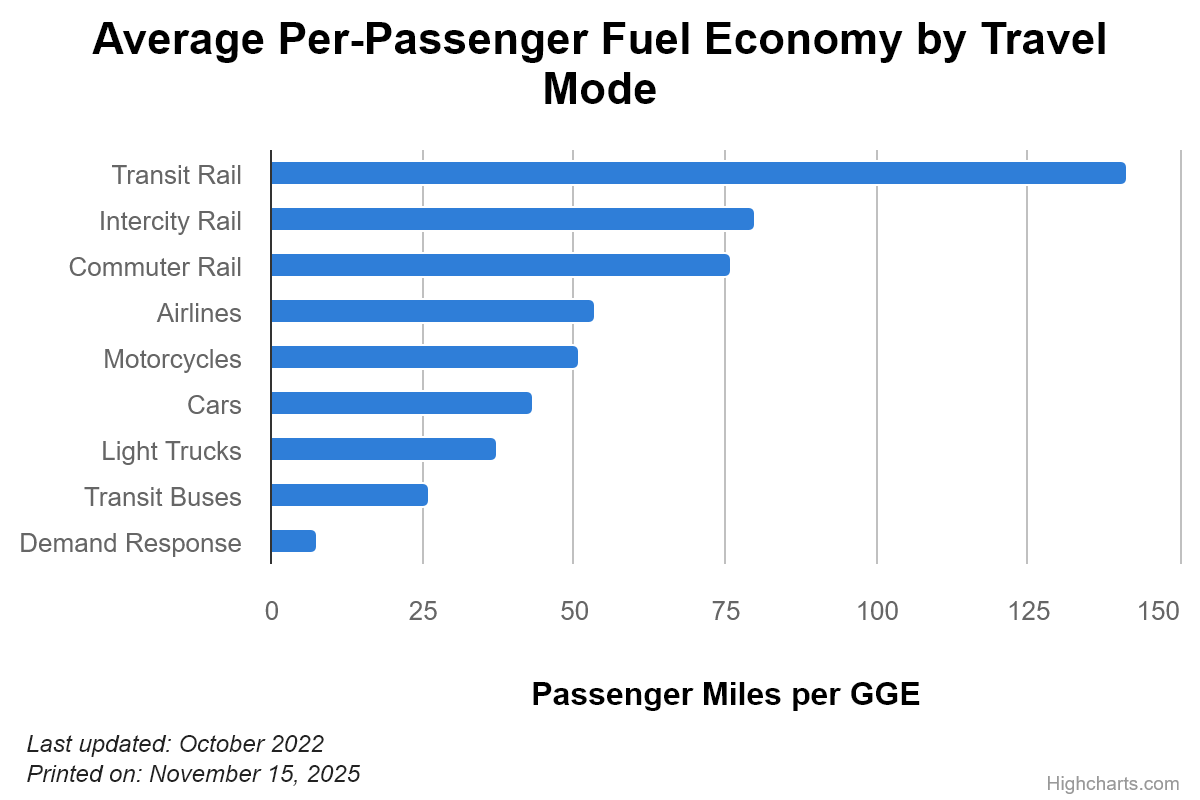
I hate cars. They are so commonplace that no one ever questions how awful they truly are. The average commute time in the US is around 26 minutes, and 77% of US commuters drive to work, while only 3% take public transportation.7 Cars are also incredibly energy inefficient and far more deadly than other forms of transportation. Forty thousand people die annually due to vehicle collisions in the US, and according to the below chart, transit rail is around 3-4 times as efficient as cars are in terms of average per-passenger fuel economy.8 Objectively, more robust access to public transportation would reduce greenhouse gas emissions, lower energy demands, decrease commute time to work, and kill less people.
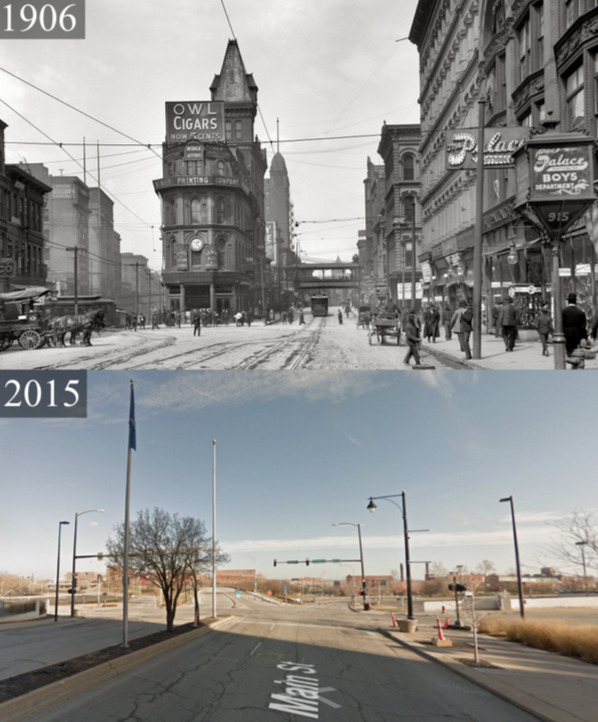
Historically, pedestrians and bikers, a.k.a most people, owned the streets; if you look back at old images of the US you can observe this (pictured below). In the early twentieth century, when cars were really only driven by wealthy hobbyists, traffic deaths soared, and in response, automakers pressed the government to restrict pedestrians from the streets. Expectedly, this marred the image of the automobile industry, so they aggressively campaigned the idea of "jaywalking" to shift blame for pedestrian deaths from cars and drivers to the victims themselves; pedestrians were "death-seeking" fools if they didn't take sole responsibility for their own safety.9 This campaign was incredibly successful, as still now, Americans are far quicker to cast blame on pedestrians for their deaths in traffic accidents instead of on careless drivers or the automobile industry as a whole. With increasingly unaffordable car insurance, awful resale potential (a brand-new car loses 50% of its value once it is driven out of the car lot it was bought from), barriers to getting drivers licenses, energy inefficiency, and deadly design, cars really are an engineering tragedy. Trains are the future.
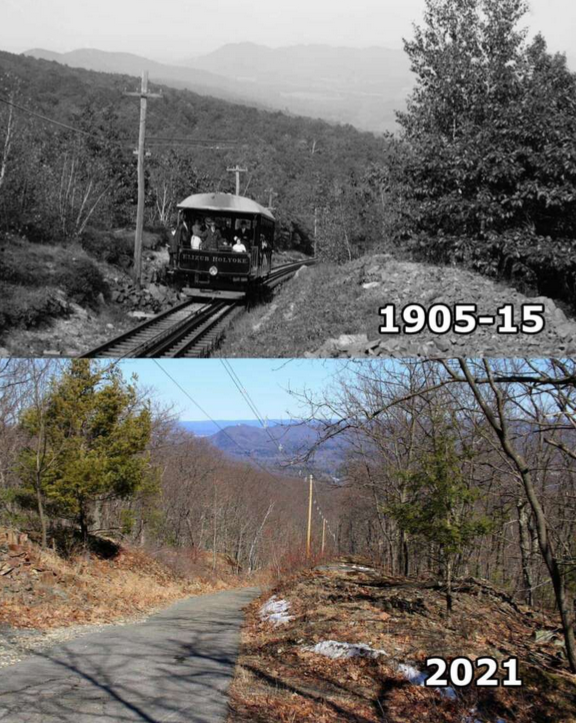
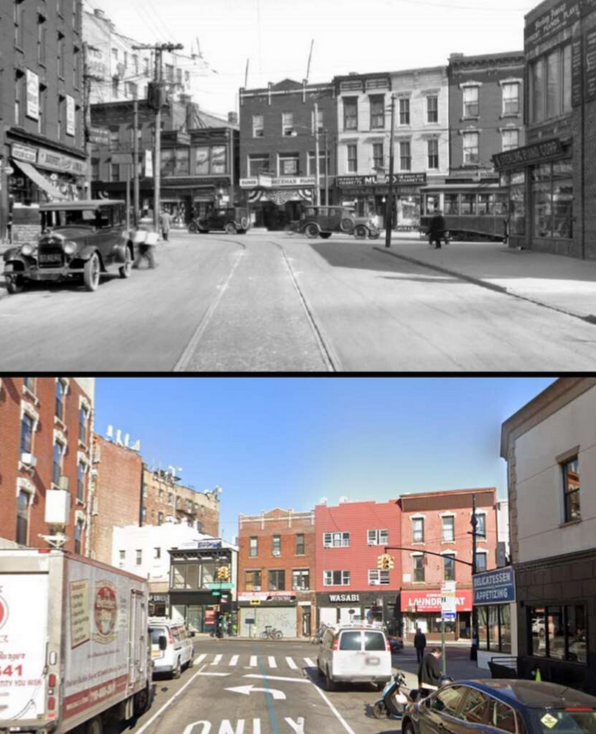
Here are some other interesting comparison photos.
There are a lot of other things I want to rant about cars, but I am tired and have been sporadically working on this post for the last 8 months (I have a bunch of other random content for separate parts), so I will send this off for now. Cheers, and I hope you like trains more.