Timeline: Sept 2024-May 2025
Location: Hatsopoulos Microfluids Laboratory
Supervisor: Irmgard Bischofberger
Mentor: Ippolyti Dellatolas
Research Area: Mechanical Engineering
Introduction
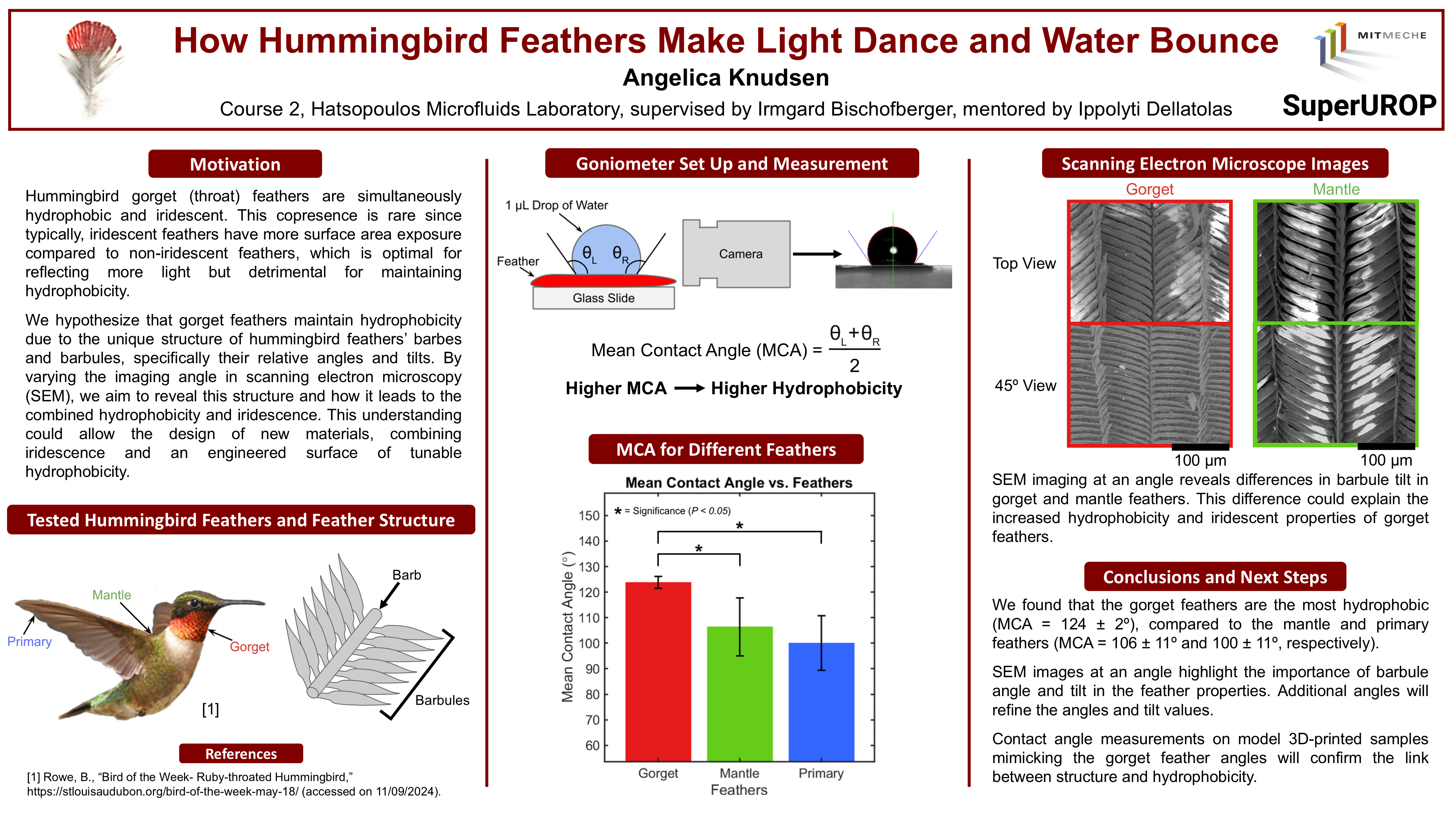
Hummingbirds are unique in that their feathers boast two extraordinary properties simultaneously: superhydrophobicity and iridescence. Generally, iridescent feathers in birds are less hydrophobic than non-iridescent ones. However, hummingbirds’ iridescent feathers exhibit a special evolutionary trait: flattened and hollowed melanosomes, called platelets. Usually, melanosomes, which are the cells that provide brown pigment, exhibit either hollowness or flatness in birds. The co-presence of hollowness and flatness is extremely rare and, thus far, has only been described in African starlings, trogons, and hummingbirds. This trait, paired with the intricate structure of gorget (throat) feathers, characterized by microscopic barbes and barbules, is hypothesized to result in combined iridescence and superhydrophobicity. Water-repelling feathers present an evolutionary advantage for hummingbirds since raindrops can slide off their body, avoiding feathers getting soaked and heavy which would prove detrimental to the bird’s flying abilities. Iridescence allows birds to visually communicate with their species, signaling mates or rivals.
We propose to reveal the geometry of the hummingbird’s hierarchical feather structure and how it leads to combined superhydrophobicity and iridescence. Using this, we will build an experimental model system of a synthetic version of the gorget feather to see how different geometric parameters can affect the hydrophobicity of a material. This experimental model system could influence the design of future materials that need to be hydrophobic and iridescent, such as clothing.