Timeline: 1 week in August 2024
Semester-long class project for 2.671 (Instrumentation and Measurement)
Paper in ASME format
Abstract
Feathers can vary hydrophobicity through differences in their microstructure geometry. These microstructures, known as barbs and barbules, can be emulated through 3D-printed materials at an enlarged scale to probe how different parameters of feather-like ridges influence hydrophobicity. The design includes five three-millimeter-wide circular samples featuring barbule-like ridges with different widths and angles. To characterize hydrophobicity, a two-microliter drop of water is placed on a sample surface, and a goniometer measures the mean contact angle (MCA), where higher mean contact angles indicate greater hydrophobicity. Wider ridges decreased hydrophobicity quadratically, with a leading coefficient of (-2.37 ± 0.92)×10^(-3) º/µm^2, while steeper angles increased hydrophobicity linearly, with a slope of (7.0 ± 3.8)×10^(-1), which is consistent with the theory behind feather hydrophobicity.
Technical Details & Skills
CAD: Autodesk Fusion 360
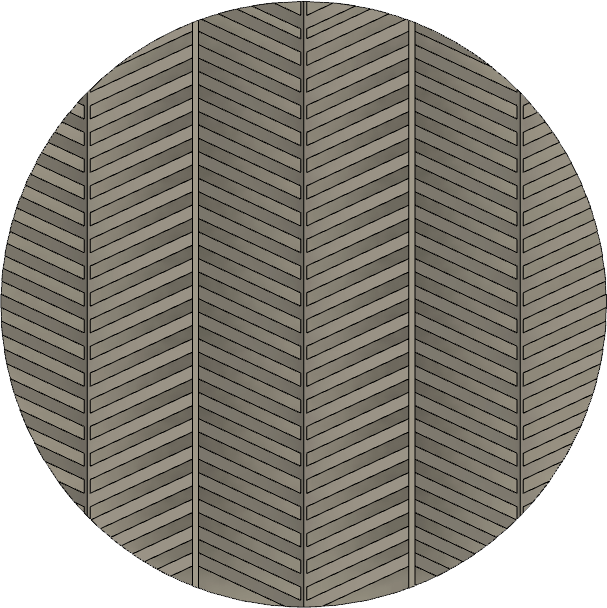

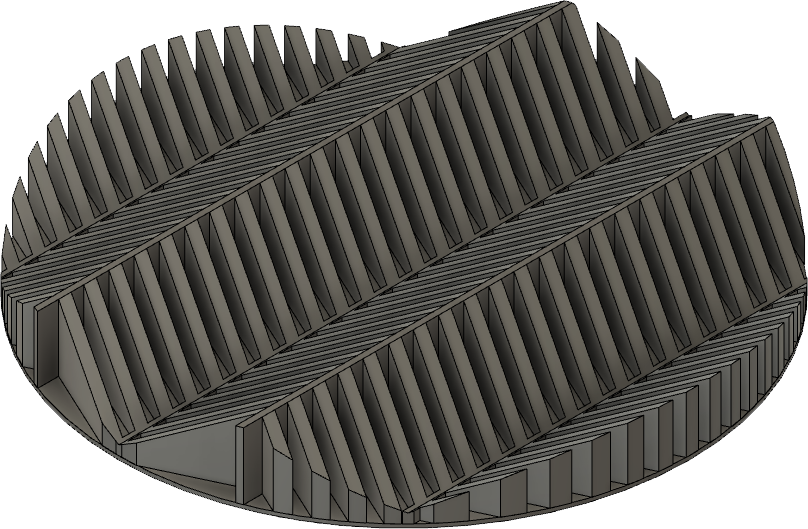
Sample CADs of a 3mm wide circle with 60-micron-wide ridges and 120-micron-spaced ridges. This project aims to vary two geometric parameters: ridge width and ridge angles. The top view illustrates the width of the ridges. The side view illustrates the angles of the ridges